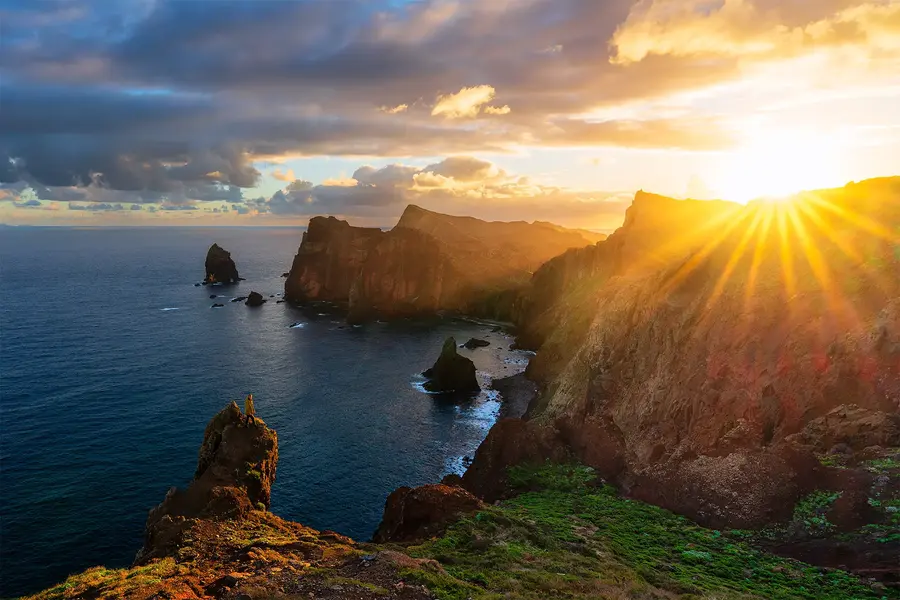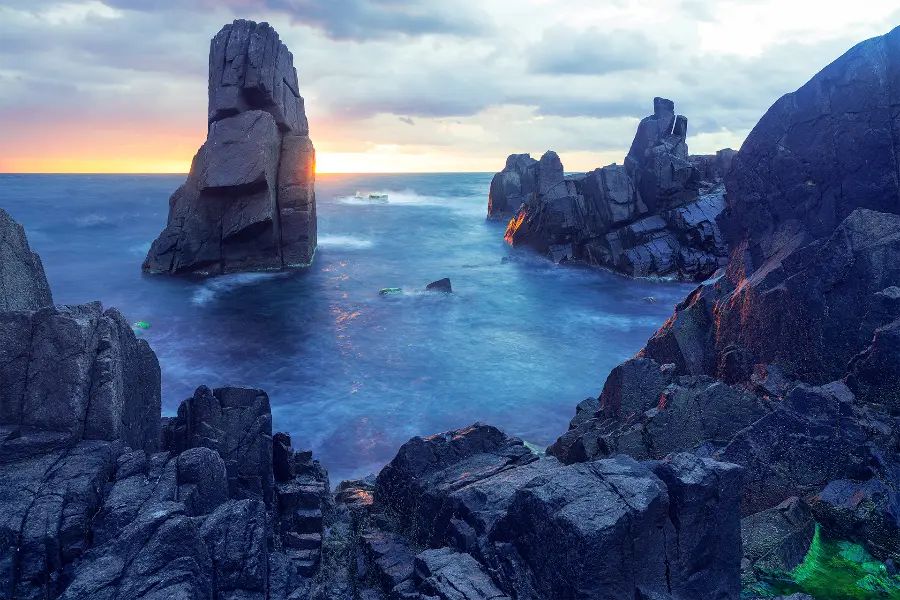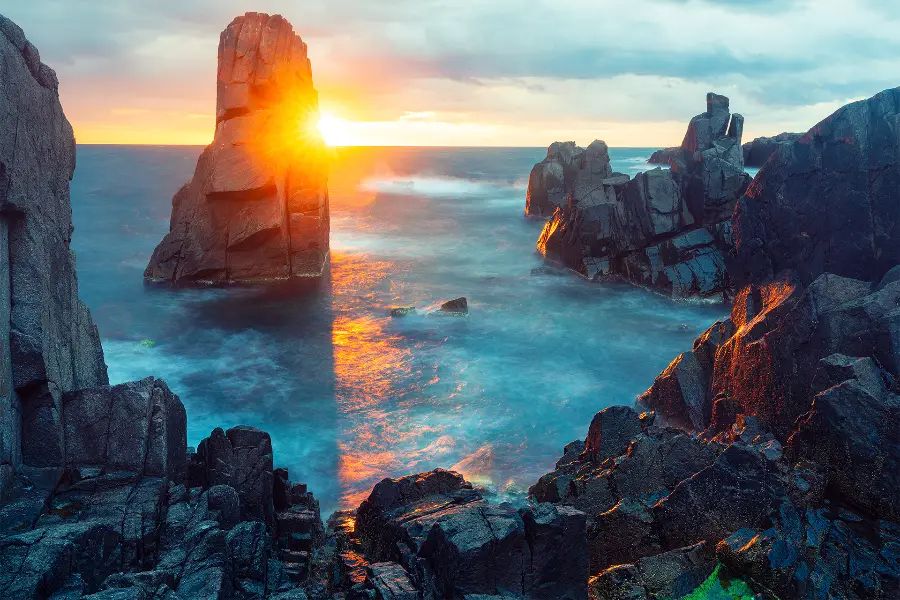

This photograph came from a fairly simple plan: find the position in advance, know where the sun would rise, and use a long exposure to soften the movement of the sea around the rocks. The conditions, however, were less predictable. Rain, wet rocks and rapidly thickening clouds left little time to react once the light appeared. In this article I break down the planning, composition, camera settings and RAW processing behind the final photograph — including the compromises that became part of the shot.
Planning Before Sunrise

We visited Palikari Rock during the previous day before attempting to photograph sunrise. The main reason was practical rather than photographic: I wanted to see how to reach the location and whether it would be safe to descend to the rocks in darkness. I had also looked at photographs made there by other photographers. They helped me understand the possible viewpoints and decide roughly what kind of composition I wanted before arriving in the dark. PhotoPills gave me the expected position of the rising sun relative to the rock. At the same time, I followed the weather forecast in several different apps. Rain and clouds were expected that morning, although the cloud cover eventually became considerably denser than I had anticipated. For this photograph that was still preferable to a completely clear sky. The clouds gave the background more structure, although they also meant that the useful light could disappear very quickly.
Choosing the Position and Composition
The rocks were wet and slippery after the rain, so the position was partly determined by safety. There was a lower viewpoint that could have given me a different foreground, but I decided not to descend any farther. I used the Sony FE 16–35mm F2.8 GM and made the final frame at 26mm. I wanted enough width to include the surrounding rocks as a strong foreground while keeping the sea, the main rock formation and the cloudy sky in the same composition. The position of the sun was an important part of the frame. I waited for it to reach the edge of the tall rock, using the rock itself to partially block the direct light. The reflection then continued through the centre of the image and connected the bright horizon with the foreground. The photograph therefore combines some advance planning with the limitations I found on location. The viewpoint was not simply the lowest position available — it was the lowest one I was comfortable using on wet rock.
Camera Settings and the Long Exposure
The final exposure was made with a Sony α7R II and Sony FE 16–35mm F2.8 GM: 26 mm · ISO 100 · f/16 · 6 seconds · ND8 filter · tripod The ND8 filter allowed me to extend the shutter speed to six seconds while keeping ISO at 100. My intention was to smooth the movement of the sea and create a softer surface between the hard shapes of the rocks. The waves were not strong enough to produce quite the effect I had imagined, but the six-second exposure still recorded movement in the water instead of freezing it. At f/16 the small aperture also produces the star-shaped diffraction around the sun. The ND filter is responsible for reducing the amount of light, not for creating those rays. When shooting directly towards such a strong light source, however, another piece of glass in front of the lens can increase flare and reduce local contrast. In this frame the sunstar was not as clean and pronounced as I had hoped. Because of the six-second shutter speed, a tripod was essential. With the composition already chosen, I could concentrate on the short period when the sun, the edge of the rock and the changing clouds came together.
When the Weather Changes the Plan

The useful light did not last long. The clouds were becoming denser above us and there was no time to rethink the entire setup once the sun appeared. This is one of the reasons why the preparation from the previous day mattered. I already knew the route, the approximate viewpoint and the position of the sun. Instead of searching for a composition from the beginning, I only had to make smaller decisions according to the conditions in front of me. The photograph is therefore not a result of ideal weather. It is a frame made within a fairly narrow window, with wet terrain limiting the viewpoint and the approaching cloud cover limiting the time.
Processing the RAW File
I processed the RAW file in Adobe Camera Raw. The global adjustments were relatively simple: Adobe Landscape profile, +0.30 exposure, -30 highlights and +10 shadows. White balance remained close to the captured value at 5300 K with Tint at -7, while Vibrance was increased to +30 and Saturation to +15. I also enabled chromatic aberration removal and the lens profile correction for the Sony FE 16–35mm F2.8 GM. Color Grading added a subtle separation between the warm and cool parts of the image. The highlights were shifted towards a warm tone at H55 / S20, while the shadows received a restrained cooler tone at H250 / S10. The more important part of the processing was local adjustment. Instead of pushing the entire image in one direction, I used several masks — including a sky mask, color-range selections, a brush and a linear gradient. This allowed the bright sky, the warm reflection in the water, the rocks and the foreground to be controlled separately. The screenshots show the actual Camera Raw settings used for this image. They are not intended as values to copy onto another photograph. Their purpose is to show how global adjustments and local masks can work together when a scene contains both direct sunlight and deep shadow.
What Mattered Most
Looking back at this photograph, the camera settings were only one part of making it work. Scouting the location in daylight, checking the sunrise direction and following the weather gave me a framework before I ever placed the tripod. Just as important was knowing when not to follow the original idea too far. A lower viewpoint might have changed the composition, but wet and slippery rocks made it an unnecessary risk. The final photograph is therefore not the result of finding one perfect setting. It came from preparation, a limited amount of time, a few compromises and adapting the original plan to what was actually happening in front of the camera.