
After several days around Provadia and Sladka Voda, it was time to continue with the second part of our autumn journey – Ruse. If you have not read the first part of the trip, dedicated to Provadia and its surroundings, you can find it in the blog.
Cherven Fortress

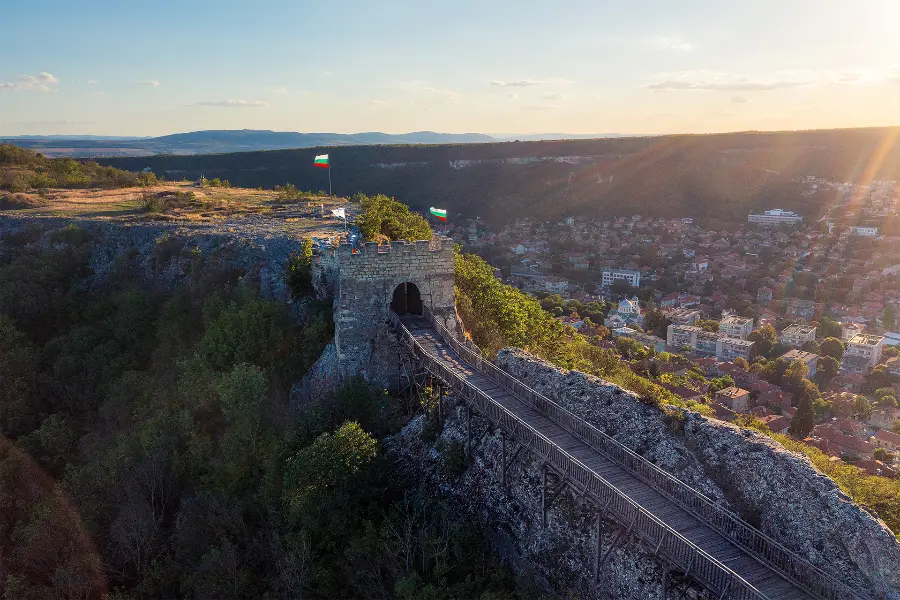
Before reaching Ruse, we had one more stop – Cherven Fortress, standing on a rocky plateau above the village of the same name. During the Second Bulgarian Empire, Cherven grew into an important military, administrative, religious and commercial centre. At its height, the medieval town occupied the ridge above the Cherni Lom River and had a complex system of fortifications, churches, residential buildings and workshops.
At the entrance we bought a small guide to the fortress, and the man at the ticket desk told us a little more about the history of the place. From there we started climbing the more than 200 steps towards the plateau. The climb passed almost unnoticed, and at the top we found the remains of the medieval town together with wide views across the surrounding valley.
We spent about an hour following the circular route, taking time to read the information from the guide, explore the ruins and, of course, make a few photographs with the drone. Archaeological research at Cherven began in the early twentieth century, with regular excavations continuing from 1961 onwards. Research and conservation work are still carried out at the site today. Individual structures have undergone conservation and partial restoration, but Cherven has not been rebuilt as a reconstructed fortress – most of what you see are archaeological remains that still reveal the layout of the medieval town.

The most remarkable surviving structure is the three-storey defensive tower on the western inner wall. Unlike most of the medieval city, the tower has survived almost entirely intact and is considered one of the best-preserved examples of medieval Bulgarian defensive architecture. Its authentic form was used by architect Alexander Rashenov as the model for the reconstruction of Baldwin’s Tower at Tsarevets in 1933.
The tower has an unexpected connection with a much more modern story as well. Its image appears in the final episode of the fifth season of Game of Thrones as part of the city of Meereen. Only a few small digital changes were made to its appearance, which makes it easy to recognise once you know what to look for. It is a curious detail, especially when you are standing in front of the actual medieval structure that inspired both a twentieth-century reconstruction at Tsarevets and, decades later, part of a fictional city on screen.
After the walk, we continued towards Ruse, where we settled into the apartment we had rented for the next few days.
Ruse – The City That Surprised Us
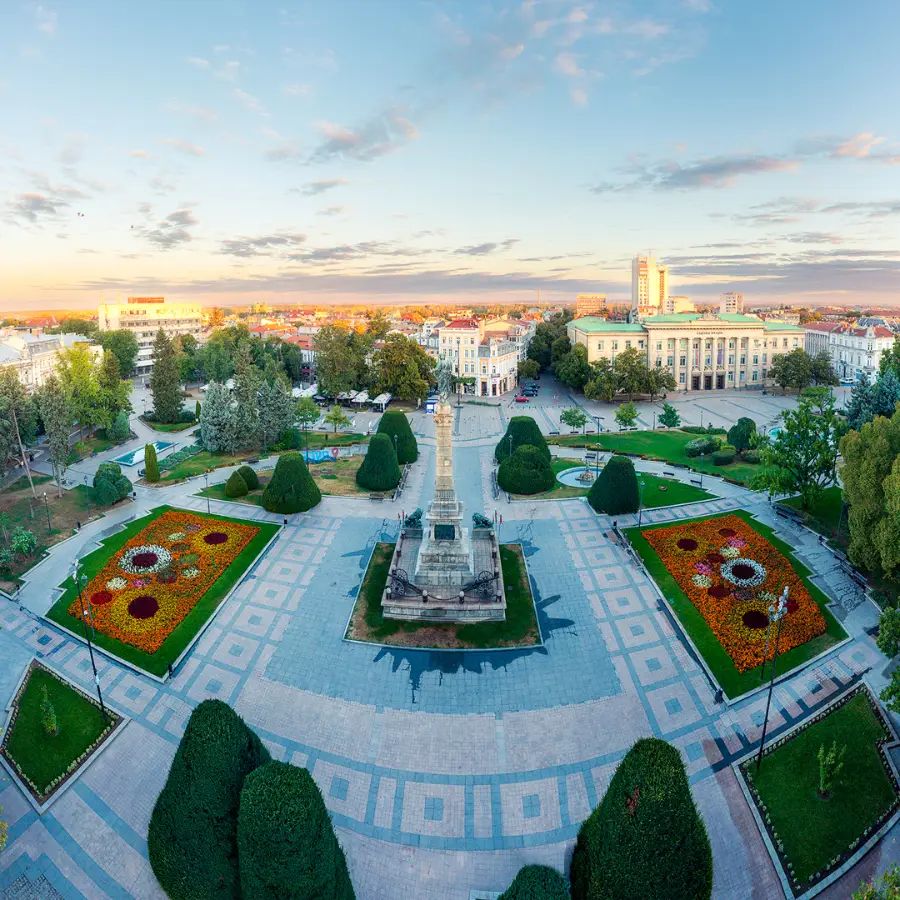
Within our first few hours in Ruse, we began to understand why the city was making such a good impression on us. The centre is filled with beautiful buildings and interesting architecture, while parks seemed to appear everywhere we walked. At one point we even started calling Ruse the city of parks.

After a short break, we went out for a walk before dinner. The weather gave us an unexpected gift – clouds gathered over the Danube and turned the sky into a wonderful backdrop for the sunset.
That evening we visited RazBIRachi, where we ordered a tasting selection of craft beers. It is a place we would happily recommend. That was how our first day in Ruse came to an end.

The next morning, after an early sunrise and breakfast, we headed to the Museum of Transport and then continued towards the Youth Park. It clearly deserves more time than we could give it on this trip, so we left a proper exploration for our next visit.

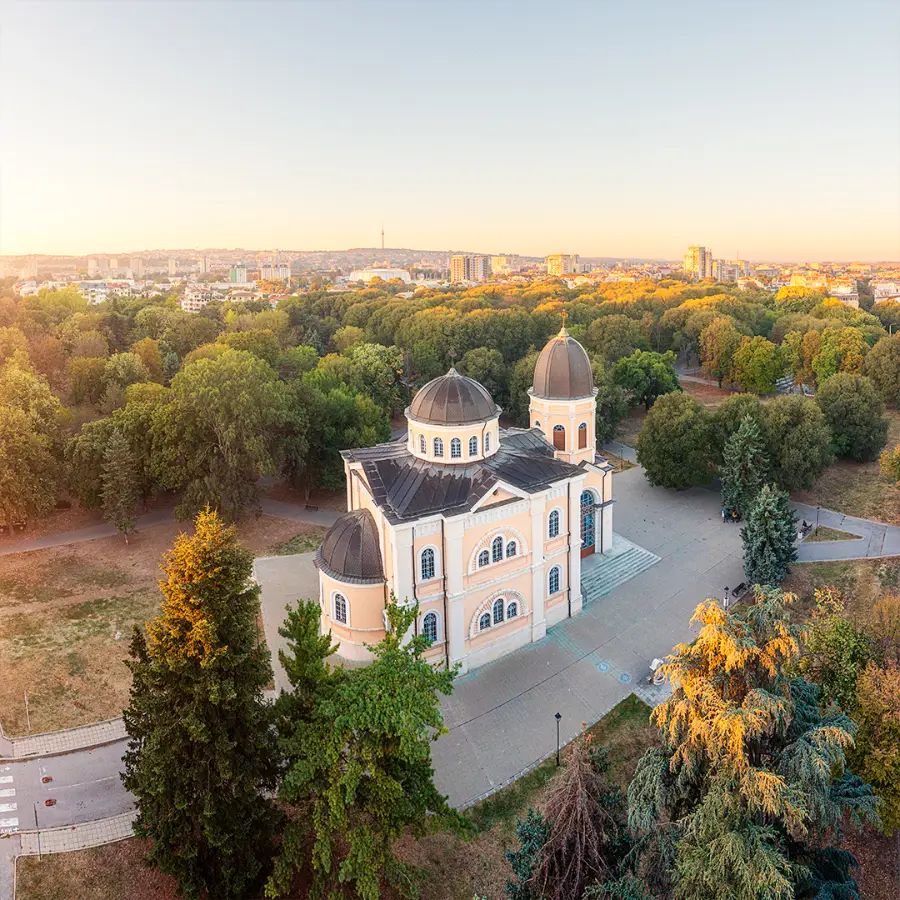
With limited time before the museums closed for their midday break, we stopped for coffee and then headed towards the centre for lunch. On the way, we crossed yet another park, this one home to the Church of All Saints.

The history of the church turned out to be quite remarkable. Built in 1898, it was demolished in 1975. The authorities of the time decided to construct the Pantheon on the site and place there the remains of prominent Bulgarians. Years later, a decision was made to rebuild the church – a process that took around two decades.
The story made us curious enough to enter the Pantheon of National Revival Heroes and see what was behind its monumental exterior. Thirty-nine prominent Bulgarians are buried there, including Lyuben Karavelov, Zahari Stoyanov, Stefan Karadzha, Panayot Hitov, Baba Tonka, Nikola Obretenov, Panayot Volov and Angel Kanchev. Hundreds of participants in Botev’s detachment, the Cherven Voda revolutionary detachment, the April Uprising and the Bulgarian Volunteer Corps are also commemorated, their names inscribed inside. Beneath the gilded dome, an eternal flame once burned, but it was extinguished after the fall of Todor Zhivkov’s regime.
After lunch we continued walking through the city, although the many kilometres on foot were beginning to catch up with us. Ruse, however, still had more to show us.
One of the small places that caught our attention was an underpass beneath one of the roundabouts. Instead of being just a passage from one side of the road to the other, the space between the underpasses had been turned into a tiny park with benches, greenery and a drinking fountain. Details like this added a lot to the impression the city left on us.

Towards the end of the day we once again headed to a location for photography, then continued towards the riverside to watch the sun disappear over the Danube.
We had dinner at Martinovata Kashta, where the cheesecake definitely deserved a special mention. Our final day once again began with sunrise, followed by more of Ruse’s museums, a walk beside the Danube and dinner at Terasata, overlooking the river. Afterwards, we returned to the centre to see another side of Ruse beneath the city lights.
Sunrises and Sunsets Along the Danube
Sunrises and sunsets gradually became a defining part of our stay in Ruse.
Every morning we were up before six and heading out to photograph the sunrise. Slowly, the city began to wake around us – first the people walking their dogs, then those setting off for work or an early walk. The light gradually pushed through the darkness, and the day began in one of the best ways we could imagine.


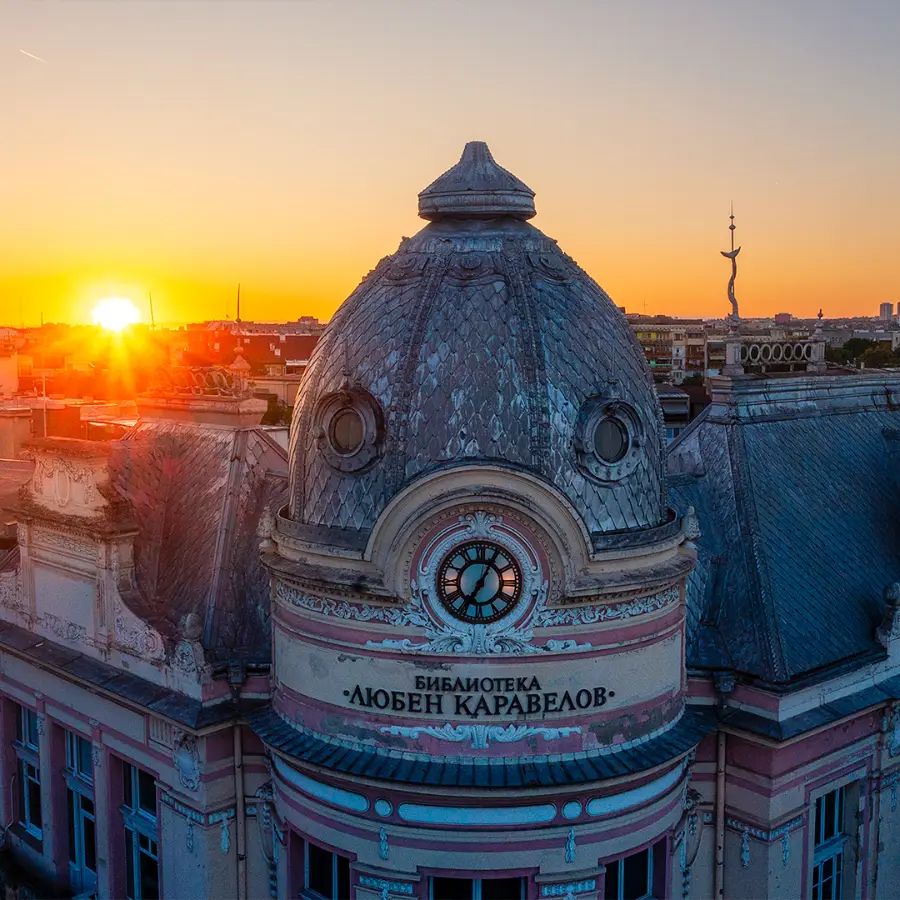
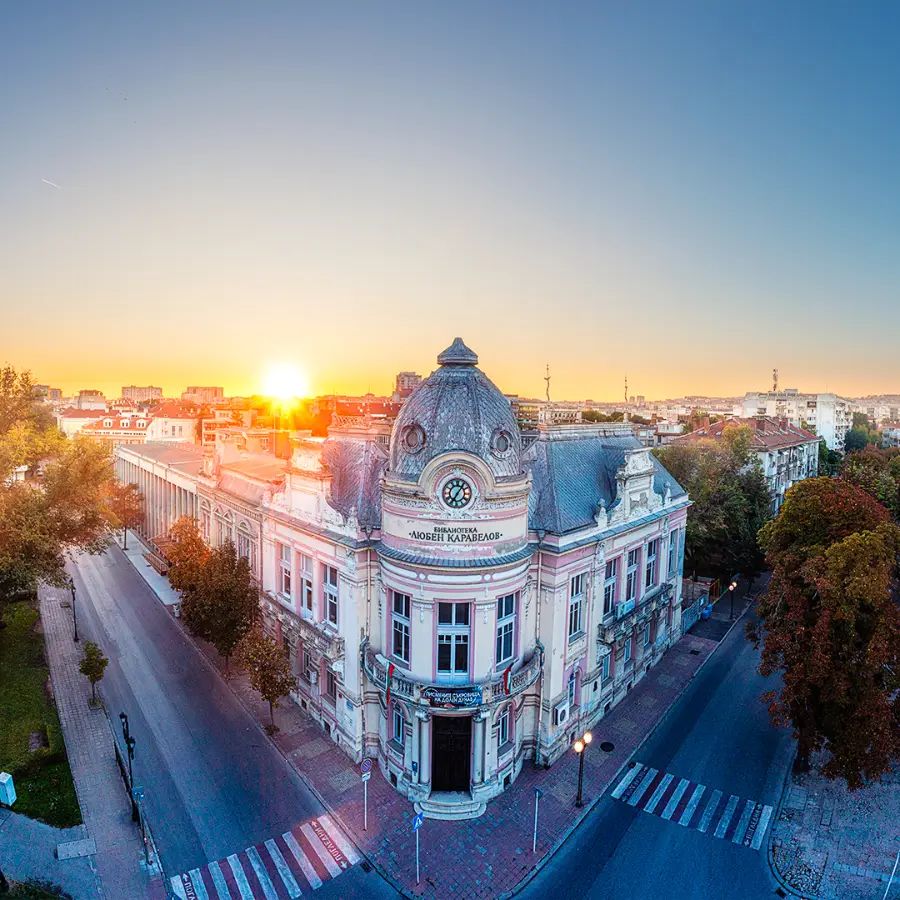
One morning we watched the sunrise near the Regional Historical Museum and the Lyuben Karavelov Library. Once again, we found ourselves in a small park – further proof of our growing impression that Ruse really is a city of parks.
Later we went to the Church of All Saints to take photographs, but by then the sun was already too high and the light we wanted was gone. So we decided that before leaving Ruse, there would have to be one final early morning.
The evenings had their own character as well. After a break at the apartment, we would head back towards the riverside to watch the sun set over the Danube. Later walks through the centre revealed another face of Ruse, shaped by illuminated buildings and the lights of the city at night.
The Museums of Ruse
Ruse turned out to offer much more than beautiful architecture and walks along the Danube. In only a few days we managed to visit quite a few museums, each presenting a different part of the history, culture or natural world of the city and the region.
Museum of Transport – The Museum of Transport was one of our first stops in the city. Walking there from the centre took us around 20–30 minutes. When we arrived, the museum had not officially opened yet, but a friendly member of staff welcomed us and immediately handed us a stationmaster’s cap and signalling baton so we could take a few photographs beside one of the locomotives. As we explored the museum, he told us more about the exhibits, and afterwards we continued outside, where locomotives and railway carriages are displayed. Among the most interesting exhibits are Bulgaria’s first locomotive and three historic railway carriages – those of Tsar Ferdinand, Prince Boris and Princess Clémentine of Orléans, the mother of Tsar Ferdinand.
Zahari Stoyanov Museum – I definitely enjoyed the Zahari Stoyanov Museum. It contains personal belongings of Zahari Stoyanov and his daughter Zaharinka, together with information panels that tell the story of his life and work. The interactive displays are a particularly interesting addition, allowing visitors to test what they have learned and discover more about his life in a different way.
Baba Tonka Museum – The Baba Tonka Museum did not entirely match our expectations, as we had imagined a larger collection and more information. Looking back afterwards, however, I realised that we had still learned quite a lot about the life of this remarkable woman. The story of the Obretenov family is especially interesting and reveals the important role they played in Bulgaria’s national liberation movement. The museum also displays the skull of Stefan Karadzha.
Regional Historical Museum – The Regional Historical Museum in Ruse is impressive, with a rich collection that traces the history of the region through different periods. One of the sections we found most interesting was dedicated to Cherven Fortress. The scale model of the fortress and the video with a 3D reconstruction stood out in particular, making it much easier to imagine how the medieval site may once have looked.
Eco Museum with Aquarium – The natural history exhibition turned out to be one of the most interesting museums we visited in Ruse. On the ground floor there are aquariums with fish species typical of the Danube, along with live reptiles including a boa, python, iguana and turtle. Upstairs, a large mammoth model stands near the palaeontology hall, where fossils of mammoths and mastodons are displayed. The collection also includes the only lower jaw of the earliest mammoth to have lived in Europe. The exhibition continues with collections of birds, mammals and other animals, while interactive tables with tasks, videos and additional information make the visit much more engaging. One small but very useful detail was the availability of lockers where visitors could leave their bags while exploring the museum.
Kaliopa House Museum – Kaliopa House is interesting both for its own story and for the glimpse it offers into the lives of wealthier citizens of Ruse during the nineteenth century. The collection includes tableware, clocks, jewellery, clothing, accessories and various objects brought home as souvenirs from travels. Upstairs, the interior of a wealthy urban home has been recreated, including a music salon, bedroom and a room for the lady of the house. The story of Kaliopa herself and of the house adds another layer to the visit and helps bring nineteenth-century society in Ruse a little closer.
Ruse – A City We Would Return To
Our journey came to an end, but Ruse left us with the feeling that this would not be our last encounter with the city.
In only a few days we managed to see a great deal – a fortress, museums, parks, the Danube, beautiful sunrises and sunsets, and several different sides of one of Bulgaria’s most interesting cities. At the same time, many places were still left unexplored.
Ruse clearly still has much more to show us, and we hope that one day we will return and continue discovering it.